

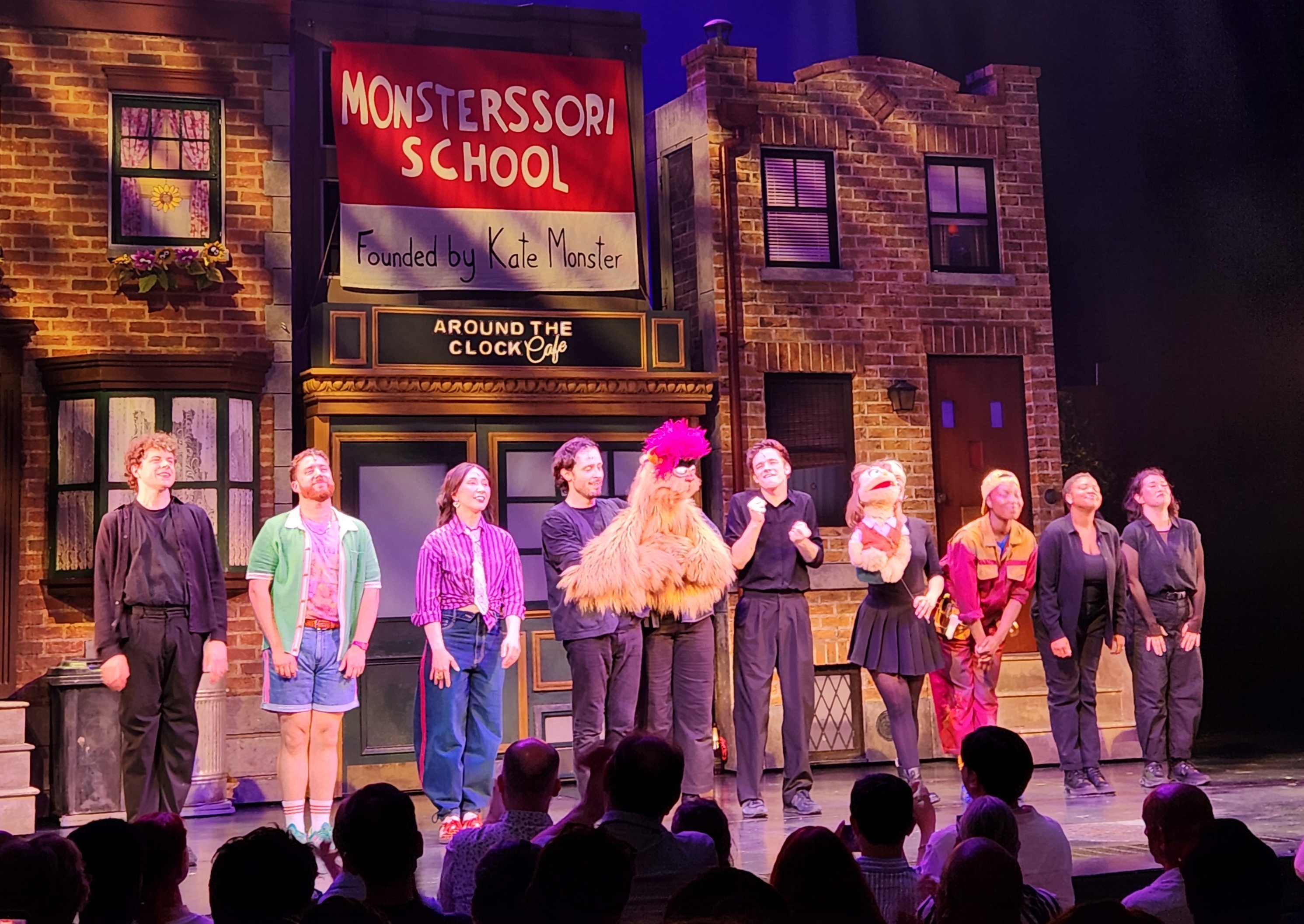
Avenue Q, Shaftesbury Theatre
Clique ici pour la version française 🇫🇷
In 2012, I saw Avenue Q at the Théâtre Bobino in Paris. As a young theater kid, I was still relatively new to musicals. I remember discovering a surprising show—and, above all, witnessing outstanding performances by the actor-singer-puppeteers. I have no specific memory of the translation (other than the criticism it received), only a vague recollection of a script that was funny, irreverent, and at times pretty filthy. Fourteen years later, I find the script is still funny and irreverent, but ultimately more impactful than crude.
London’s Shaftesbury Theatre is celebrating the 20th anniversary of Avenue Q’s West End debut by reviving the show under the direction of its original director, Jason Moore. Avenue Q truly left a mark on its era, won a slew of Tony Awards, and has undoubtedly become a classic—an unusual kind of classic.
Its creators (Robert Lopez, Jeff Marx and Jeff White) built the show as a pastiche of the educational show Sesame Street, borrowing its stylistic conventions. Flesh-and-blood characters rub shoulders with puppets and live alongside one another; they live on the same street (or rather, avenue) and share their private lives. And the musical—much like the TV show—explores the turmoils, disappointments, joys, and questions that shape young adulthood, though with a distinctly grown-up sense of humor. Everyone can easily identify with these characters as they step into adult life, searching for a job, a home, love, and—above all—a purpose.
This is precisely what drives young Princeton (a puppet) to join this New York avenue and its community: Kate Monster (a sweet, furry young puppet), Trekkie Monster (a shaggy, porn-obsessed monster), and roommates—also puppets—Nicky and Rod. Three human characters also live there: the young couple Brian (Oliver Jacobson) and Christmas Eve (Jasmine Beel), as well as Gary Coleman (Dionne Ward-Anderson). Remember the child star from Diff’rent Strokes? Here, he has become the building’s superintendent. The group will go through a series of trials that allow each of them to grow, become their own person, and ultimately find fulfilment—all set against a backdrop of love, friendship, hangovers, one-night stands, and porn.

The book is full of charm, though the story itself is ultimately quite simple. Avenue Q makes a point of speaking directly to the audience and dispensing little nuggets of wisdom. The staging, very frontal in its approach, along with the message screens reinforce this « educational show » vibe—which, of course, only makes the outrageous things said on stage even funnier. You laugh a lot. Every now and then, you’re even truly moved.
The songs by Robert Lopez and Jeff Marx, gleefully marry juvenile humour with sharp wit. A perfect example is the song « My Girlfriend Who Lives in Canada, » performed by Rod. Rod is a gay, Republican puppet who shares an apartment with Nicky and refuses to admit his homosexuality. In doing so, he naturally refuses to speak about it to his friend or neighbours. Cornered into an « outing »—albeit a well-intentioned one—that he never wanted, he loudly proclaims that he has a fiancée living far away in Vancouver. The lyrics are both hilarious and delicate, much like the situation of the conflicted character at their heart: absurd yet deeply touching.
Avenue Q’s writing walks a tightrope, pulling itself back just as it veers into the risqué. When Trekkie Monster sings « The Internet Is For Porn » with his dazed expression and sepulchral voice, the entire audience can’t help but burst into laughter. Contrasting with the refinement of Kate Monster—who has to endure this performance—Trekkie embodies a collective consciousness that is slightly coarse, unapologetic, and finds itself hilarious in the process.
We are no longer in the early 2000s, and what seemed incredibly irreverent back then inevitably feels less so today. Sensibilities have changed, and so has musical theatre. The book may no longer seem quite as insolent, but it remains just as funny. Speaking of the passage of time, I found myself reflecting on how I perceive certain moments—and especially certain songs—now: « If You Were Gay » and « Everyone’s A Little Bit Racist ». The former has arguably lost some of its humour and bite; it feels almost heavy-handed. The message of the latter hasn’t changed one bit. Yet, society has been shaped by a multitude of movements over the last twenty years. Isn’t it a tad odd to hear a character talking about « anti-white racism » in 2026?
Beyond the broad comedy, Avenue Q is also filled with suspended moments that often carry messages of acceptance. My favorite song is probably « There’s a Fine, Fine Line, » performed by Kate Monster after a romantic disappointment. The emotion the wonderful Emily Benjamin conveys through her puppet is absolutely breathtaking.
Incidentally, who does the singing, and how does it all work? Each puppet is operated by a performer dressed entirely in black— whose presence you almost forget as the show unfolds. That would be a mistake. You have to watch them—all of them. Their faces mirror their puppets’ emotions, even though their eyes never meet anyone else’s gaze. It is a remarkable feat, especially since some performers embody multiple characters on stage simultaneously. Each one has a highly stylized, almost caricatural voice, and represents a distinct archetype to portray. Emily Benjamin, Meg Hateley, Noah Harrison, and Charlie McCullagh deliver astonishing physical performances : as they animate their puppets, they move seamlessly between cartoon, romantic comedy, and coming-of-age storytelling.
If Avenue Q still makes us laugh and moves us, it is because the musical speaks to us about ourselves: our past hopes, our moments of surrender, and our achievements. I don’t watch it the same way at forty as I did at twenty-six. These young, furry creatures offer so many opportunities for identification ; precisely because they are archetypes. We inevitably find ourselves in one of them. Or another. Or both. In search of meaning, or in search of ourselves.
When I said the show feels more impactful to me now, I meant that the journeys of these imaginary characters resonate more deeply with me today. I have a better understanding now of the importance of community. Their boundless friendship and their (equally boundless) humour feel like an oasis in our suffocating world. The writers have even reworked a few passages and added some updates, reminding us—in the song « For Now »—that things are going wrong, but only for a while. Soon, it will get better, because everything comes to an end. Even Trump. It is always a pleasure when a musical reminds us of that.
Laisser un commentaire